
AI data centers are running into a wall, and it isn't compute. It's the power and space it takes to move data between switches. Co-packaged optics (CPO) is the industry's answer, and in 2025 it moved from lab demos to shipping hardware.
This guide explains what a CPO switch is, how it differs from the switches most data centers run today, why it saves so much power, and what the tradeoffs are.
What is a CPO switch?
Every data center switch has to turn electrical signals into light to send data over fiber. In a traditional switch, that conversion happens in optical transceivers plugged into the front of the box. In a CPO switch, it happens millimeters from the switch chip itself, and fiber connects almost directly to the chip package.

How is a CPO switch different from a traditional switch?
The difference comes down to how far the electrical signal has to travel before it becomes light.
| Traditional switch (pluggable optics) | CPO switch | |
|---|---|---|
| Where optics live | Transceiver modules in front-panel ports | Optical engines inside the switch chip package |
| Electrical path | Centimeters of circuit board traces to the front panel | Millimeters from chip to optics |
| Signal processors (DSPs) | Needed in every transceiver to clean up the signal | Not needed |
| Parts to buy | Switch plus one transceiver per port | Switch with fiber connections built in |
| Servicing optics | Swap a module by hand | Handled at the system level |
At low speeds, the traditional design works fine. At 51.2 Tb/s and beyond, pushing signals across the board and cleaning them up again takes a large share of the switch's total power.
Why does CPO save power?
CPO switches use over 50% less power than traditional switches with the same specifications. That figure comes from Micas testing at 40 °C ambient with full line-rate bidirectional traffic. In that test, a Tomahawk 5 switch with 400G DR4 pluggable optics drew 3,267 W, and the Tomahawk 5 CPO switch drew 1,626 W, a 50.23% reduction.

The savings come from two places:
- No DSPs. Each pluggable transceiver carries a digital signal processor to recover signals that degraded on their way across the board. With the optics next to the chip, those DSPs aren't needed.
- Shorter electrical paths. Less distance means less power spent driving signals, and less heat to remove from the system.
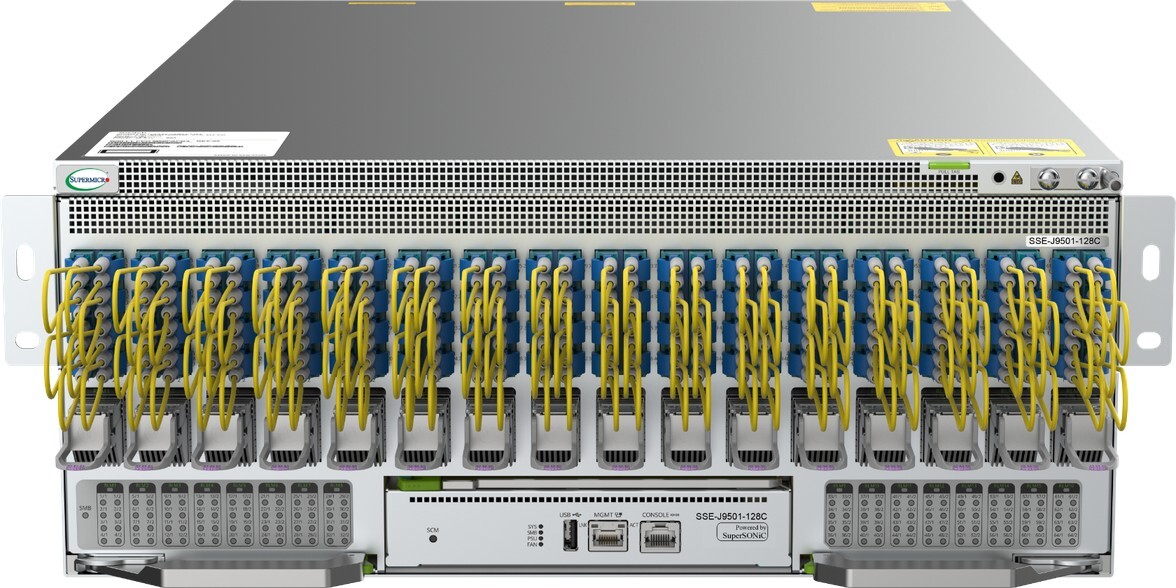
Less heat also changes cooling. The Micas 51.2T CPO switch ships as an air-cooled 4RU system, so it fits existing data center racks without a move to liquid cooling.
There's a cost benefit too. Because the optics are built in, there are no transceivers to buy for each port.
What are the tradeoffs?
The biggest question buyers ask about CPO is reliability. In a pluggable switch, a failed transceiver is a quick swap. In a CPO switch, the optics are part of the chip package, so a failure matters more.
That's why reliability testing has been central to CPO's path to production. For the Micas 51.2T CPO switch:
Laser and component qualification data: Broadcom.
The laser source, the component most likely to wear out, also stays pluggable, so it can still be serviced from the front of the box.
Where is CPO today?
CPO is no longer a research project. In March 2025, Micas Networks put the industry's first 51.2T CPO switch system into volume production, developed with Broadcom.
| Micas 51.2T CPO switch | Specification |
|---|---|
| Switch device | Broadcom Tomahawk 5 Bailly (BCM78909) |
| Optical engines | Eight 6.4 Tb/s silicon photonics chiplets |
| Ports | 128 × 400G FR4 |
| Form factor | 4RU, air-cooled |
| Fiber connectors | LC or MPO |
| Manufacturing | Micas co-owned factory in Malaysia |
| Availability | In volume production since March 2025 |
NVIDIA and Broadcom are also bringing CPO to next-generation platforms, a sign that CPO is becoming a standard part of AI networking.
Frequently asked questions
What does “CPO switch” mean?
What does CPO stand for in electronics?
Is CPO better than pluggable optics?
Are CPO switches available now?
See the Micas 51.2T CPO switch
Micas Networks builds data center switches for AI-scale networks, including the industry's first CPO switch in volume production. Explore the specs or talk to our team about your deployment.
Explore the CPO switch →