
Open networking is no longer a philosophy — it's a market trend with numbers behind it. The worldwide SONiC market in data center switching is projected to exceed $5 billion in 2026, with SONiC switching revenue set to double between 2025 and 2027 to $8 billion (650 Group; Cisco citing 650 Group). But if your networking is open, why would your optics be locked down?
Open networking means you choose the NOS (e.g., SONiC) that fits your operations, you choose the switching hardware that fits your budget, and you automate and manage the fabric on your own terms. That freedom is the whole point — a market measured in billions doesn't run on marketing speak.
That freedom extends all the way down the stack — to the transceivers that carry the traffic. If your fabric is open but your optics are single-vendor, the network is only as open as its most closed component.
A transceiver is only useful if it interoperates with the switch, the NOS, and the surrounding network. In an open environment that means real decisions, not defaults:
Source optics from more than one supplier without breaking the network — the port doesn't dictate the vendor.
Multi-vendor optics that work across different switch vendors and NOS versions — so you're not the one discovering integration problems.
Transceivers validated side by side on the same fabric — interop becomes engineering reality, not a datasheet claim.
Open stays open, top to bottom. Choice, control, no lock-in — down to the optical layer.
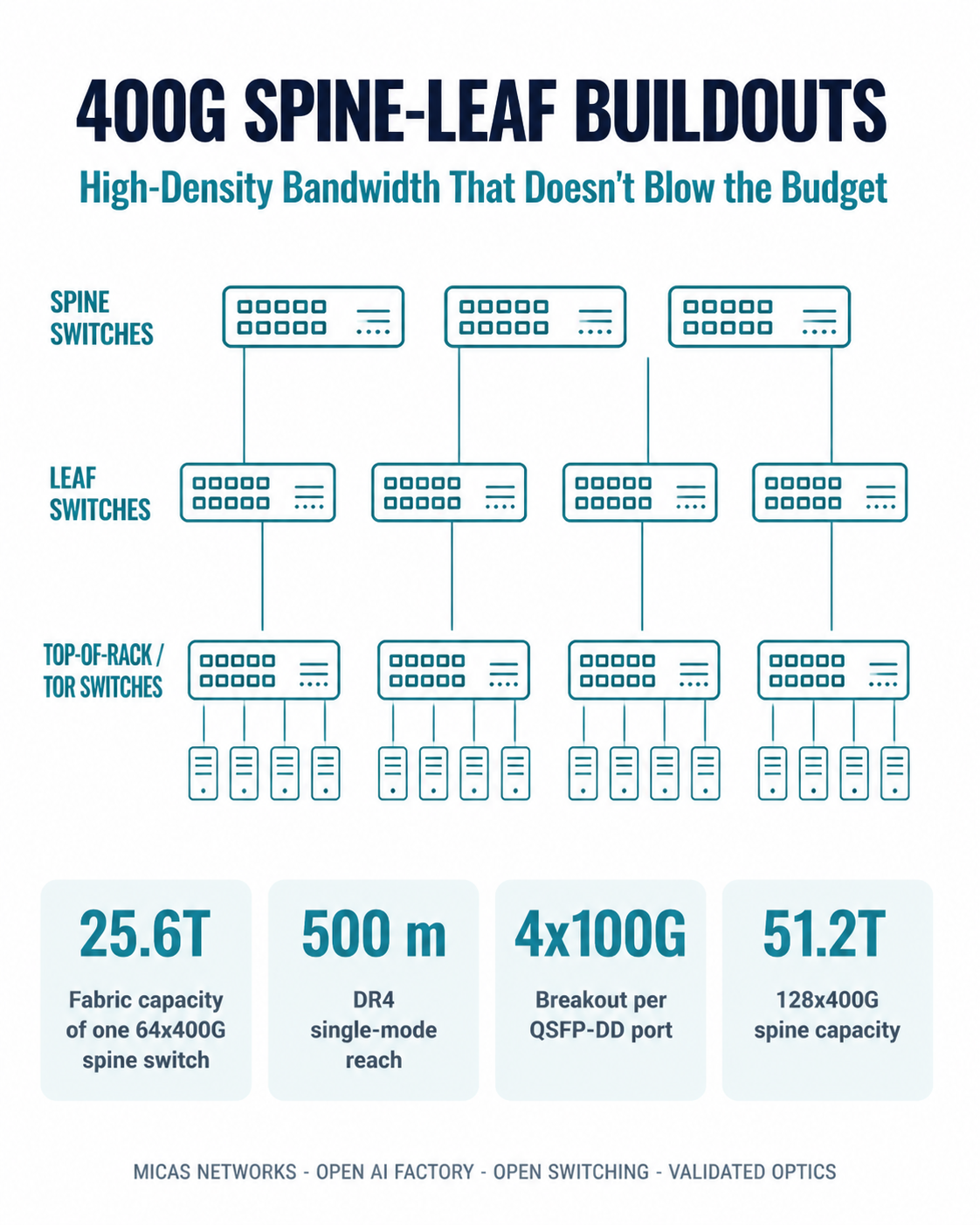
We treat optics as part of the open promise — not an afterthought. It's why the difference between "open in theory" and "open in practice" is a system, not a slogan:
Open fabric from Broadcom, running open NOS environments — openness is the default, not the exception.
Optech and Vitex transceivers validated side by side on the same fabric — choice at the port level, no single-vendor lock-in.
The Micas integration layer proves components interoperate before they reach your data center — you inherit tested reality, not discovery.
When customers run open networking with optics from multiple qualified vendors, "open" stops being marketing and becomes engineering reality.
We’re at booth #316 with Broadcom showcasing our Open AI Factory story — planning an 800G or 1.6T build? Have it IRL!